
Yes my dear friend you’ve found it;)
Thanks a lot this is
“Unsere Fahne flattert uns voran”- the famous song the nazy pioneers.
BTW what does mean from Germnans?
Yes dear Librarian i knew that the Alexander I march has a Prussian roots;)
Newertheless thanks for the infor and care;)
Your posts really have always the highly intriguing background.
Cheers.
[qote]“Unsere Fahne flattert uns voran”- the famous song the nazy pioneers.
BTW what does mean from Germnans?[/quote]
“Our flag is fluttering us ahead”
]quote]Your posts really have always the highly intriguing background.[quote]
Thank you for your kindness, my dear Mr. Chevan. So here is another musical quandary for you – do you know which originally NSDAP-ordered and subsequently by SA troopers frequently performed, intrinsically socially intonated marching song, was officially incorporated into the communistic block as an international symbol of the working class struggle? I am assuring you – that one is musically superbly arranged too! 
And please, don’t worry - I know that I owe you certain information about various half-forgotten airplanes constructed in USSR, but don’t worry – I shall pay that liability very soon. In the meantime – all the best. 
You’re welcome Chevan
“Unsere Fahne flattert uns voran”:
“Our banner flutters before us”
or
“Our Flag Flutters in Front of Us”
The History Place - Hitler Youth
http://www.historyplace.com/worldwar2/hitleryouth/index.html
The Fahnenlied (Banner Song) written by Hitler Youth Leader Baldur von Schirach, is sung here by Berlin Hitler Youth members, ending with the final refrain…
Unsere Fahne flattert uns voran
(Our banner flutters before us)
Unsere Fahne ist die neue Zeit
(Our banner represents the new era)
Und die Fahne führt uns in die Ewigkeit!
(And our banner leads us to eternity!)
Ja, die Fahne ist mehr als der Tod
(Yes, our banner means more to us than death)
Schirach at the Nuremberg War Crimes Trials (1946) :
http://www.historyplace.com/worldwar2/hitleryouth/index.html“I bear the guilt for having trained the young for a man who murdered millions. I believed in that man. That is all I can say in my defense.”
Sorry for interference, honorable Mr. Eller, but aforementioned translation actually is erroneous one. You see, that FLAG LEAD US/FLUTTER US ahead.
German expression “fluttert” represents the Present Continuous Tense of the German verb “fluten” (to flatter, to wave, to flap) – therefore “…is fluttering” is perhaps more appropriative expression.
It has to be mentioned that The New York Times, however, considers aforesaid expression as a variant of the Present Simple Tense – “Our Flags Lead Us Forward”. Perhaps this translation – due to its clarity - is the most acceptable one. Here you have the link:
http://movies.nytimes.com/movie/139910/Hitlerjunge-Quex/overview
Finally it has to be mentioned that English expression “flutters us” is not very usual, but nevertheless correct one, especially in poetry:
“Ah, love makes slaves of us all in the end, she flutters us, moulds us, makes us scream and then chains us once we are broken.”
But never mind – the most important thing is that we all know the accurate meaning of those words.
BTW - That material about Lockheed P 80 is absolutely magnificent. Thank you very much for that piece of information. I shall be there very soon as well.
In the meantime - all the best.
Thank you kind sir for the clarification
“Our Flags Lead Us Forward” it is then.
I am very glad that you enjoyed the article about the Lockheed P 80. Many thanks for the compliments. I have also found your posts to be very well researched and informative.
I would also like to compliment you sir on your very proficient and eloquent use of the English language. You are a gentleman and a scholar.
Best Wishes,
George
Hmm, fluten means to flood, the verb is flattern, but you’re right about the tense. I don’t know how the NY times got that translation, but it’s nowhere near a literal translation, which happens quite often as it seems when lyrics or poems get translated. “Flattern” is what flags do when the wind blows, I would choose wave as my verb of choice if I’d have to translate literally. “Voran” is pretty tricky to translate as it means both a position and a direction in german. If I would have to paint a picture I would say imagine a medieval war standart for what is meant, it’s both ahead and leading the way.
I don’t know if it’s at all possible to translate it correctly without making those two statements individually but if I had to choose, I’d probably take the NY times one here.
“Our flag leads us, waving ahead” would be my shot for literal translation.
Honorable Mr. Eller,
About the middle of May in the year of 1357, while the Duke of Lancaster was besieging the town of Rennes during the interminable series of wars between the English and the French, a knight bachelor named Bertrand du Guesclin asked whether any Englishman would try a passage of arms with him. Accordingly, the battle was halted while a formal joust was held between Du Guesclin and Sir Nicholas Dagworth, consisting of three courses with spears, three strokes with axes, and three stabs with daggers. The two, according to the chronicler Froissart “behaved most gratuitously, and parted without hurting each other. They were seen with pleasure by both armies as examples of a truly decent and honest behavior.”
That principle, which today entails performing an public activity vigorously and yet courteously and either winning or losing gallantly, was the product of the human attitude toward intense respect for the rules of behavior between decent human beings.
In this world of ours we got it pounded into our heads that those standards are unnecesary and even non-existing entities. Being thankful for your unrestrained and indeed splendid efforts toward protection of these values, I am assuring you that you will have the everlasting support of this community. Your generous statement testifies to the people’s confidence in you and that intrinsic effort of yours.
As a tiny, poetically encircled reflective expression of my personal appreciation of your truly warm personal address, I am hereby making a quotation of a poem that is, I feel, most appropriative connotation of gratitude, as well as a true, old-fashioned reflection toward some good ole times.
[b]When I was just a tow-head kid
Not knowin’how things stood,
I got a lot of lessons boys
In telling bad from good.
The teachers tried and priest too
And dad would oft explain,
But none could reach me half as well
As cowboys like John Wayne.
They stood for truth and justice clear,
No cloudin’up with gray.
There was black or white, the wrong or right
In everything they say.
Their honesty and decency,
Their way of speaking plain
Are only part of what I owe
To cowboys like John Wayne.
I grew to love this country son,
Old Glory’s stars and stripes,
To stand up proud for what US were
And never quit a fight.
As I look at the world today
I wonder what became
Of those great values once we learned
From cowboys like John Wayne.
It seems like we’re all the villains now,
With no God, no pray, no shame.
Without decency and loyalty,
Without cowboys like John Wayne.
Dear Lord I pary we find ourselves
Before we go insane.
And may we live as they once lived,
Those cowboys like John Wayne.[/b]
May God bless you and keep you.
Hmm, fluten means to flood…
Indeed, my dear Mr. Drake, but on the other hand we have some almost standard poetical expressions: Die flutende Menge, or even better one: Das Volk flutet durch Die Straßen . On the other hand that word “voran” is pretty tricky to translate, thus allowing possibility for a misinterpretation.
That’s a very high leveled German Mr. Librarian - and nobody would have used such a grammatic in a populistic song in need for the Nationalsocialists :rolleyes:
Hooray for courses in German spelling and grammatic:
A flag just can’t flood - or ‘fluten’ - that’s the point.
A Flag can wave - ‘flattern’ or ‘wehen’ etc.
Sehr geehrte Herr Splinter 54 - yes, you are absolutely right– that was my evident mistake. However, thank you for your kind words.
Glauben Sie mir - Jetzt ich habe das Flimmern vor den Augen! Es ist so wie immer - wer in dem Augenblick suchen muss, wo er braucht, findet schwer auch. After all, in this very moment meine Gedanken hin und her flattern lassen.
BTW – Is that pretty peculiar expression perhaps from “de Watterkant”?
I don’t know - i gave up in the German Lessons when it came up to Kant and:
‘Ich will,
was ich muss,
was ich kann’
‘I want,
what i have to,
what i can’
But my most favored quote was made by H.Heine: ‘Denk ich an Deutschland in der Nacht, bin ich um den Schlaf gebracht!’ (‘If i think about Germany in the night, i can’t sleep anymore!’ - sounds better in german)
I always fell asleep in my german class, but it comes natural to me, ehehe, always had a B, even without reading the book sometimes 
On the other hand after 13 years of school a little rest is well deserved imho :mrgreen:
Oh, and you have survived those immortal lessons dedicated to Walther von der Vogelveide, my dear Mr. Splinter 54? Jesus!:shock:
Even today I have problems with those strange feelings in my stomach when I call to mind those German lessons in our old K und K type of a Gymnasium, in those wee small hours of the morning, just about at 07.15 H.
Ich saz uf eime steine
Und dahte bein mit beine:
Dar uf satzte ich den ellenbogen
Ih hete in mine hant gesmogen
Daz kinne und ein min wange
Do dahte ich mir vil ange.
Um Gottes Willen!:roll:
We made all those tales about the Minnesängers twice in the German and History lesson - i made them three times, because i had chosen History as one of my main subjects once :roll:
Don’t bring up all those bad memories Mr. Librarian 
But now that you have mentioned that, i will say that also, when i meet some of my old friends back at the Oktoberfest tomorrow (Holydays yay!)
In that case – all the best, my dear Mr. Splinter 54! Ach, ja: und vergessen Sie nicht, bitte, auch eine Küß für fesche und schöne Dirndl vom Nachbartisch!
Or perhaps the old song, interpreted by Maria Helwig is more suitable for this occasion:
Rosen, Tulpen, Nelken- alle Blumen welken, Stahl und Eisen bricht, doch Meine Liebe nicht!
And thank you very much, honorable gentlemen for a beautiful and enriched evening. God bless you all!
To the Most Dear and Honorable Librarian,
Sir, I would like to offer you my most sincere and heartfelt thanks for your beautiful reply. I am deeply touched by your kind words. Indeed, they are proof that chivalry is still alive. And I assure you sir that my feelings toward you are mutual; you have my utmost respect.
I was deeply moved by the recounting of the tournament at Rennes and the joust between Bertrand du Guesclin, “the Eagle of Brittany” and Sir Nicholas Dagworth. And the poetic tribute to John Wayne, “the Duke” was equally inspiring. I have always admired the decency and dignity that he portrayed.
Again, thank you so much.
God Bless You.
With Kindest Regards,
George


Bertrand du Guesclin, “the Eagle of Brittany”
http://en.wikipedia.org/wiki/Bertrand_du_Guesclin
http://www.1911encyclopedia.org/Bertrand_du_Guesclin
http://www.historyofwar.org/articles/people_guesclin.html
http://books.google.com/books?spell=1&q=“Bertrand+du+Guesclin”&btnG=Search+Books
http://www.google.com/search?q=+"Bertrand+du+Guesclin+"&hl=en&lr=&as_qdr=all&start=0&sa=N
Sir Nicholas Dagworth
http://books.google.com/books?id=V6ofAAAAMAAJ&pg=PA236&lpg=PA236&dq="sir+nicholas+dagworth"&source=web&ots=wdyza-l_q7&sig=5srUMEOTFWcYGcCNZNELr02r2qI
http://books.google.com/books?spell=1&q="sir+nicholas+dagworth"&btnG=Search+Books
John Wayne, from the western: The man who shot Liberty Valence
http://www.youtube.com/watch?v=9mQMDWfKaW8
It seems for me my dear honorable Librarian that you mean the famous 1930’s soviet song the “March of red aviators” or " the higher, higher and higher" ( “все выше, выше и выше”).
This soviet march was copied from the Nazy anthem " The song of Horst Vessel".
The ONLY difference was the words.
The germans sing “Main Fuhrer, Main Fuhrer, Main Fuhrer …”
But i know for the sure that the many other early soviets songs had the Germans roots.
Have i guess?
And please, don’t worry - I know that I owe you certain information about various half-forgotten airplanes constructed in USSR, but don’t worry – I shall pay that liability very soon. In the meantime – all the best.
Oh thatnks my friend. Be sure i will not worry - you always do what you’ve promised;)
Good luck our amazing serbiam friend.
Yea dear George.
Our banner flutters befor us …
La La lA La La …
It’s a great song - the such internal energy, such passion;)
Damn … it’s not very well to listen this song too much times…
And now dear mst Librarian - the little exercise for your experienced brain
What the NAzy march was in the basis of the one of Israeli armies anthems?
The little addition.
This is the Israeli anthem"Tanks makes the history" (Shirjon ose istoria)
It seems for me my dear honorable Librarian that you mean the famous 1930’s soviet song the “March of red aviators” or " the higher, higher and higher" ( “все выше, выше и выше”). This soviet march was copied from the Nazy anthem " The song of Horst Vessel". The ONLY difference was the words. The germans sing "Main Fuhrer, Main Fuhrer, Main Fuhrer… But i know for the sure that the many other early soviets songs had the Germans roots. Have i guess?
Well, not exactly, my dear Comrade Исаев… oh, pardon me - I mean my dear Standartenfuhrer von Stirlitz. This time you have overlooked that tiny remark socially intonated marching song.
BTW – I was really impressed with that deeply inspiring avatar you have here. My God, when was that? Yes… back there in 1977! You know, my dear Mr. Chevan, when that magnificent Soviet TV serial (Семнадцать мгновений весны - Seventeen Moments of Spring) was aired, streets were completely empty! Literally! The only similar situation I remember happened 6 years before, when that magnificent Bonanza-gallop across the screens of our TV sets in those long, usually busy Saturday afternoons, made my little home town as empty as an desert road . Yes, those were the days, my friend…
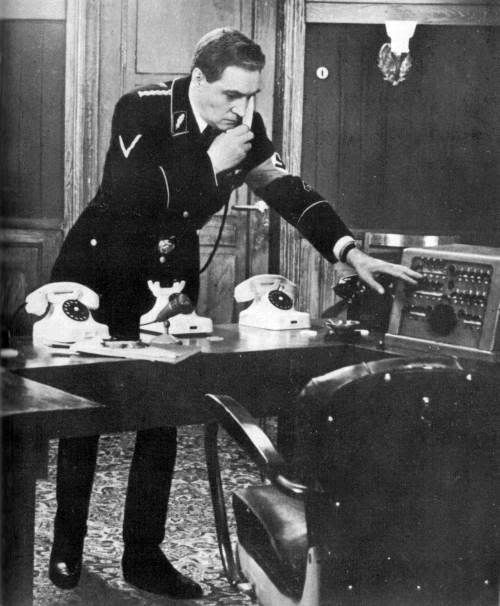
Seventeen Moments of Spring
But never mind that – we have to concentrate on our main theme: that aforementioned mysterious marching song. You see, my dear Mr. Chevan, although there is no decisive agreement about the origins of national socialism in Germany, there can be no doubt that actually aforesaid political movement was a specific response to the most severe economic crisis in the XX century, greatly reinforced by the appeal to tradition and history. It sounds unusual, but Nazism was able to appear both revolutionary and traditional. The ideas of a national form of socialism, appealing to national unity against the Marxist doctrine of class struggle, and of a revolutionary dynamism under a charismatic leader, were grafted on to ideas of racial superiority, territorial expansion, and martial spirit, which went far back into the German past. The graft, however, was not wholly successful – the different parts were not completely absorbed into one another – but still the result was a stronger and tenacious economic growth.
It was through an alliance between the revolutionary and the conservative that Hitler and NSDAP came into power in Germany. Often neglected fact, however, is the verity that the original program of the National Socialist German Worker’s Party - adopted in 1920 – was socially very radical: it demanded action against big industries and department stores, the expropriation of land needed for national purposes (hence its appeal in rural areas!), the abolition of unearned income and ground rents. The manifesto went on to declare that the state’s first responsibility was to uphold the livelihood of its citizens, and that all citizens should have equal rights and responsibilities within the state. It also stated that jobs should be acquired by merit, not patronage or favoritism, that large business should be nationalized, with workers entitled to a share in their profits. It also called for improvements in the education system and in maternity benefits, tougher penalties for criminals, and carried a guarantee of religious freedom – with one ominous exception: no Jew was to be allowed German citizenship!
Other clauses included the German’s people right to Lebensraum, in which the population could expand to fulfill its “God given destiny” (whatever that means), that non-citizens (read: Jews and Gypsies!) should be ineligible for state-provided benefits, and an immediate halt to all non-German immigration.
For all that NSDAP desperately needed an appealing marching song, an composition with a sufficiently harmonic rhythm and melodic gesture, also equipped with a strong resemblance to the socialy conveyed tradition of common effort, and NSDAP did not hesitate to borrow extensively from their main opponents – Communists.
The answer was an poetic adaptation of a popular worker’s song Brüder zur Sonne, zur Freiheit, a song indeed written by a Russian Leonid P. Radin (“Смело, товарищи, в ногу”) in 1897, and originally transferred to Germany via translation of Russian verses, undertaken by an distinguished member of the SPD, Mr. Hermann Scherchen back there in 1918. However, officially recognized version that the melody was composed by the German conductor Hermann Scherchen, who was a Russian POW during the World War I, and who supposedly brought this song to Germany was wrong – legally protected musical composition was actually composed in 1927. by a popular Viennese composer Fred Raymond, who also have had arranged some other highly popular wartime melodies, including renowned ‘Es geht alles vorüber, es geht alles vorbei’ (‘Everything Will Come to Pass’, 1942) and who was paid by NSDAP to do the job!

SA Rally, Berlin 1936
This variant of the old worker’s song, known as “Brüder in Zechen und Gruben - Brothers in the pits and mines” has been officially issued in 1928 and mentioned in a textbook named “Arbeit fürs Volk”, arranged by M. Biebler-Willnich, as well as printed in a music sheet collection “Marschlied der Kameraden” printed by Ernst-Erich Buder in 193. In 1935. the Führungsstab of the SA Oberbayern officially declared this composition as Marschlied – Marching song of the SA units - the song with a vibrant melody and an easy-to-learn/sing text that could be sung at the end of a meeting or a march, as well as the direct counterbalance to the popular “Brüder zur Sonne, zur Freiheit” of the Communists.
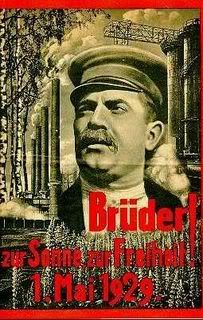
Brüder zur Sonne, zur Freiheit
The irony of fate, however, was embedded within the verity that this song was also adopted in its new, more appealing form by the coursed Red Devils, and subsequently disseminated with its old, socialist text as an international symbol of the proletariat struggle all over the world.
Nowadays this magnificent piece of musical history is available in more than 50 variants. The first one is, of course, the Russian variation:
“Смело товарищи в ногу,
Духом окрепнем в борьбе.
В царство свободы дорогу,
Грудью проложим себе.”
http://english.sovmusic.ru/download.php?fname=vnogu
And here we have the original, NSDAP version of the very melody:
http://www.thepaganfront.com/brangolf/sounds/Bruder%20in%20zechen%20und%20gruben.mp3
Another, indeed beautifully orchestrated version is this Czech, Largo e molto maestoso interpretation of The Worker’s Oratorium.
http://download.sovmusic.ru/m/vnogu_cz.mp3
We have the Hungarian variant too:
http://download.sovmusic.ru/m/vnogu_hu.mp3
And, believe or not, even the Yougoslav rendition of the same song:
http://www.slobodnajugoslavija.com/sound/pjistokizapad.mp3
Enjoy!
Oops, almost forgot something – sorry my dear Mr. Chevan, but I am a little bit confused: you see, there is no musical resemblance between the ''Horst Wessel Lied" (also know as “Die Fahne Hoch” - composed by SA-Mann Horst Wessel, seemingly in March of 1929) and that beautiful March of the Stalin’s Aviation composed by Ю.Хайта, text by П.Герман . Please, compare those melodies yourself:
Beautiful military March of the Stalin’s Aviation
http://download.sovmusic.ru/m/marshair.mp3
… and also musically highly impressive Kampflied - the '‘Horst-Wessel-Lied’
http://www.ingeb.org/Lieder/diefahne.html
Perhaps there was some mistake when you typed that text of yours?
And now dear mst Librarian - the little exercise for your experienced brain
What the NAzy march was in the basis of the one of Israeli armies anthems?
The little addition.
This is the Israeli anthem"Tanks makes the history" (Shirjon ose istoria)
Fairly and sqarely - I am defeated, my dear Mr. Chevan! Alas, I have no idea -please, enlighten me!
Good luck our amazing serbiam friend.
Большое спасибо!
Заскочивши на минутку,
Задержалась не на шутку…
Быстро ляпаю ответ:
Всей России - привет, привет, привет!!!