Why not? it might be interesting even pure for logistic training;)
Stalin was of course an enormous blood thirsty bastard tyrant. But he’s hardly more culpable for WWII with his sometimes poor decision making than were the British, and especially, the French…
…and the Myssoliny. Who folowing his agression plans to take controll all over Middle Sea had involved the Germany into war in Africa.
Hitler DEFINITELY wanted revenge against the French for the “humiliation” 1918-1919 first and foremost–as evidenced by the use of the same rail car to sign the Armistice as was the venue for the WWI Armistice…
Yes , of course. I mind the anglo-saxon as “West” whom Hitler considered as the “brothers nation” to Germans. The revenge to France and Poland for Dancig was in agenda from most beginning of Hitlers ideology.But all those “lacks” is nothing compared to the great mission of Germany,as Hitler believed - “the saving word from bolshevism”.That’s why we know manies in west looked at him as at great leader for a long time.
The more I think of it, the less I seek answers concerning the “needs” of Hitler. What he really wanted and needed was a bed, veggie food, a place to p… and sh… and some entertainment. All the other things are about stumbling in his own pit, without realizing it was a pit because of the early succes. Very obvious for the born lunatic he was.
I guess everyone was guilty in waging war. Stalin in particular was guilty of crimes even before the war. His black mark on history is rather different from discussing timelines of world war II as he falls in the category “killer of its own population”.
Britain started the war? Oh my! Britain must have fired the first shot, then… I don’t think so. I guess wars only start when someone “declared war”. Tell that to Hitler, or Stalin, or Emperor Hirohito, or even Mussolini, none of whom bothered to declare war on anyone. Really, guys, get a grip on reality…
Well, Hitler did declare war on the US after Pearl Harbor.
So it’s clearly America’s fault for taking that seriously and getting involved in the European war when everyone could see that Germany wasn’t in the least aggressive towards any other nation. :rolleyes:
Why not?
Not just started a full-scale European war in september of1939 but also involved into that war US later, if to look at events pure formally;)
Oh my! Britain must have fired the first shot, then… I don’t think so. I guess wars only start when someone “declared war”. Tell that to Hitler, or Stalin, or Emperor Hirohito, or even Mussolini, none of whom bothered to declare war on anyone. Really, guys, get a grip on reality…
Dude, the US with their “allies” waged a dozen of wars only in 20 centure , never even bordered a to “declare a war” to somebody.Did you once heard the US “declared war” to , say … Vietnam or Iraq? Just send a bombers anywhere and - upps , we have a new war:)Usially it’s very enough to declare the “possibility of use of MDW” by somebody. Even the Britain never care to declare war to Argentine for that damned islands:)Instead both have declared the …intentions.
They shouldn’t take the Pearl Harbor seriously and entered the war agains Japane:)
So it’s clearly America’s fault for taking that seriously and getting involved in the European war when everyone could see that Germany wasn’t in the least aggressive towards any other nation. :rolleyes:
How , the Germans openly expressed the agressive to …“bolshevic” nation;) What seems makes him an sort of ally to western “democraties” in 1938 , didn’t him?
P.S. I’m too glad to see you again. All of you guys:)
It’s an unfortunate fact that many people in Western Europe and in English speaking countries were sympathetic to Hitler, not least because of his anti-communist position.
If Hitler had attacked the USSR first (leaving aside the problem of Poland being in the way), I doubt that there would have been much or even any support for the Soviets from the West.
and not least of his anti-semitism.Hitler never hided the fact he wanna draw the blood the Soviet jewry.
If Hitler had attacked the USSR first (leaving aside the problem of Poland being in the way), I doubt that there would have been much or even any support for the Soviets from the West.
I’m sure if even Hitler attacked it, the Poland should repat the role of Chehoslovakia - not a big sacrifice for a great role - the crusade to the east.
Can do nothing- my heart belong to lada:)Never breaks actually- the construction seems too primitive to been broken anything.Shame to tell you, but i’ve bought the anothe car- Hundai And presented it to my misys…
That’s a major understatement - the French spent most of the Phony War dreaming up ways to invade Russia. That’s why Weygand was in Syria before being recalled to France after Dunkirk - he was working on an invasion of the Baku oilfields launched from there.
I’ve been reading a lot about the Fall of France recently (for something I’m writing), and the more I read the more I come to the conclusion that the French had the numbers, the kit and to some extent the right tactics and strategy, but their officer corps was full of clowns and their politicians even worse. Given decent French leadership, the German invasion of France would probably have been a disaster to rank with Cannae or Teutoburger Wald. Indeed, IMO the only person to screw up worse than Gamelin was Leopold III…
Well, there is a bit of a precedent for that with Napoleon. Not that that turned out too well.
Doesn’t the French interest in invading Russia in WWII support my view that the West was hostile to Russia or, more accurately, to the USSR, as part of the general Western hostility to communism?
To some extent, yes - the French did spend a great deal of time rounding up communists, although Maurice Thorez had successfully legged it to Moscow (the French were convinced he was in Berlin).
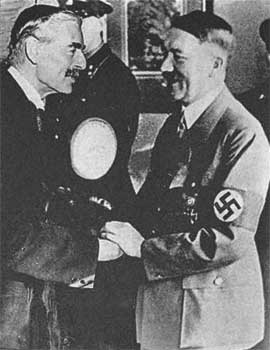
There is an interesting revisionist theory I read a few years back that states basically that Chamberlain wasn’t as weak as portrayed and knew war with Germany was only a matter of time. His focus wasn’t so much as preventing war as delaying it. The delay allowed the RAF to bring more Spitfires online and allowed a tiny British Army some room for expansion. Chamberlain may have saved Britain every bit as much as Winston did…
God , mate, the 6700 your posts here. You should be a general here:)I vote…
I’m holding out for Minister of Defense! I want to be a civilian… :mrgreen:
It may well have ended as a disaster had Hitler had his way and invaded through the only logical route of Belgium in the winter of 1939. I think there is little doubt of a Heer coup d’état --effectively shooting Hitler in the head five years earlier. I mean, everyone knew the Ardennes was impassible, except for one French colonel’s military exercise leading him to the conclusion that while motorized passage through the Ardennes would be difficult, it was by no means impossible nor particularly impracticable unless the enemy air force unwisely decides not to bomb you into a forest fire.
But I think I’d make the point that Gamelin, while not a stupid man, was as much a symptom of French military incompetence as the cause. The French high command was quite geriatric and I’m sure not many better choices were realistically available. A wholesale purge of the top leadership with promotions of younger, more dynamic officers would undoubtedly led to better results though…
I’m far from convinced about that - the attitude of Preussische Feldmarschälle meutern nicht was deeply ingrained, to the extent that the vast majority still backed him in 1945 when it was evident he had led them to a disaster far greater than was possible in 1940. I think it far more likely that the General Staff would have pushed back far more and had more influence on how the war was actually fought as a result.
No forest fires in Europe during May - far too wet. And the original quote was that the Ardennes are “impassable, provided special provisions are made”. Leopold III is the real bad actor here - he decided not to defend them, and kept this fact secret from the French. That totally screwed up their (admittedly too weak) forces in trying to slow down the Germans.
Ultimately the problem is that they were trapped in a mindset which ran at the pace of 1918, and so couldn’t adapt to the much faster rate of attack possible with mechanised transport. André Beaufre also makes a good point when interviewed for The World at War - the French had extensive experience of tanks in warfare and knew what they couldn’t do. The Germans didn’t, but knew what it was like to be on the receiving end. Throw in advances in machinery making tanks massively longer ranged and more reliable, and it’s a recipe for disaster at the Command & Staff level.
The German General Staff did fight back a good deal prior to Fall Gelb, which was why it was successful. The conclusion of the campaign was Hitler’s high water mark as a ‘great warrior generalissimo’ destined for Valhalla. Of course, this is all quite ironic since it was Hitler that pushed Generals Halder and Brauchitsch to prematurely plan and execute a campaign against the French --through the logical road networks of Belgium-- in the Autumn of 1939 that would have been an unmitigated disaster. Halder was all too well aware of this and some think his mini-Schlieffen Plan was so bad and projected so many casualties for minimal gains that he was essentially throwing things to put a damper on Hitler’s delusions of bringing the hated Gauls to their knees in a disastrous war of attrition the Allies very much wanted. It was in fact this “push-back” that enabled Manstein’s (in Churchill’s words) “sickle-cut” plan to be developed into fruition. Hitler is due some credit for his forcing his generals to “think outside the box” and other various clichés. But it wasn’t solely his domineering that resulted in the end run victory over France, it would be Hitler’s faulty claims of post hoc “See, I told you so!” that gave him the credibility to marginalize those that disagreed with his theories. Never again would the forced group consensus that earmarked Fall Gelb be, as Hitler’s supposed military prowess was now unstoppable after Fall Gelb/Rot and the Wehrmacht was bludgeoned into political submission by the Nazi organs of control leading to the absurdly unrealistic planning of Barbarossa.
As for the German officer corp ultimately submitting themselves to Hitler, this is true. But one must remember the military nightmare that unfolded for Germany did not take place overnight and few recognized the inevitably of military disaster after the retreat from Moscow in the Winter of 1941. It was due largely to what were perceived as Hitler’s early successes in the face of potential military catastrophe against France, and in the happy times if the initial advances against the Soviets. Early dissenters reading the tealeaves of unfolding disaster by the end of 41’ tended to end up dead in plane crashes (Toldt) if they spoke of an armistice too loudly. Commanders that actually stood up to Hitler were castigated and marginalized and he surrounded himself with yes men sycophants like “The Gravedigger of the German Heer” General Keitel. The rest had already cast their lot with the Nazi regime and mutiney was unthinkable in the face of the unrelenting Soviet enemy…
No forest fires in Europe during May - far too wet. And the original quote was that the Ardennes are “impassable, provided special provisions are made”. Leopold III is the real bad actor here - he decided not to defend them, and kept this fact secret from the French. That totally screwed up their (admittedly too weak) forces in trying to slow down the Germans.
You are correct; the sin of Gamlin is that he never articulated what these ‘special provisions’ were. But one thing I must take issue with in defense of Gamlin was that there were many endemic, institutional factors and political considerations that were beyond his near term control. One of which was the disconnect of the French “Methodical Battle” doctrine between the Armée de l’Air and the Armée on the ground, a reflection of the rather the inherent slowness of their combined arms approach. It would have been difficult to fix this overnight but I think there was some headway towards modernization. Gamelin’s failures were as much intelligence related as they were operational. I think one could very well make the argument that had the French Army had more time and been blooded a bit more in real combat rather than methodical menageries of fanciful prewar planning, they would have improved their tactical acumen rapidly. Had there been better coordination, I think their chances of repelling or at least stalling the Heer columns through the “greatest traffic jam Europe has ever known” (at least up until that point) of 40,000 vehicles waddling through four bad forest roads would have been much greater. The French tactical bomber force had some excellent planes, but of course far too few ones and the fighter force had less than a hundred modern Dewoitine D.520’s augmented by obsolete and borderline-obsolete-but-still-useful fighters such as the Curtis P-36’s, to oppose the 109’s. But it is true that the French Command, including Generalissimo Gamelin, ignored hysteric reports by their recon pilots of Germans in the woods. These would have been tempting targets. Even if sustained attacks more or less could have led to the same destruction of Allied tactical air elements that befell them in their belated, vain attempts to close the hemorrhage at the Meuse. I think a determine but minimal effort of air strikes driven home could have resulted in a catastrophe for the Heer in the forest.
The Belgians did employ some excellent light infantry that held up the Germans for a bit, IIRC; but yes, they beat feet and withdrew in accordance with their ‘national redoubt’ strategy. However, I also recall that a few small but strategically placed French outpost fortifications in the Ardennes held the Germans up for hours with one slowing them for at least half a day before the fort was knocked out as panzers could not traverse the steep incline around it and infantry were mowed down before they could see where the fire was coming from. Perhaps more of these Ardennes’ forts and less forts on the Maginot Line would have been a better solution, but of course hindsight is 20/20. And of course, there was the awful Dyle Plan itself. I believe Gamelin did not come up with it, but the original plan envisioned a relatively small French holding force of about ten infantry divisions employed as much for political reasons as for military ones. No one wanted to appear to abandon Belgium in a German invasion, but of course they were to act as little more than a picket force to slow down the Germans and hold them until the Bosch’s exact intentions were divined. The plan sending the best trained, equipped and most mobile part of the French Army into Belgium -and away from the real threat- came later.

 :rolleyes:
 What seems makes him an sort of ally to western “democraties” in 1938 , didn’t him?
 And presented it to my misys…