
With regards to U.S. aircraft production vs British production I have recorded the following numbers of military aircraft built from various sources.
year USA Britain
1939 5,856 7,940
1940 12,804 15,049
1941 26,277 20,094
1942 47,836 23,672
1943 85,898 26,263
1944 96,318 26,461
The allies coulden’t control where the Germans went but deploying forces from other allied nations in the USSR like in France during world war one seems perfectly reasonable. If the Soviets were particularly hostile towards the UK then they still could have used Canadians, Australians, Americans or Indians.
Hi fellas,
Just a few stats on Strategic bombing and the survival rates …
Bomber command…
From the annual totals for the whole war the official history gives 364,514 Sorties dispatched and 8325 aircraft missing, whereas according to data contained in ACM Sir A Harris’ Dispatch a total of 389,809 Sorties of all categories were dispatched during the war and 8655 aircraft went missing. The latter figure includes mining, counter measures and miscellaneous.
The average loss rate, missing aircraft only, on sorties over the whole war period was about 2.0% whereas if ‘crashed’ aircraft are included the rate increases to 2.7%. As a substantial number of aircraft crashing did so as a result of damage sustained on operations it would not be unreasonable in making any analysis, at least as far as risk is concerned, to includes them as operational losses. However it is difficult to do this using available data as it is not detailed enough.
Average Probability of Survival over the whole war, 1939-45.
Accepting Harris’ estimate for the number of aircrew who served in the the command, overall out of every hundred :
40 Survived Unharmed
7 Survived but were wounded
8 Survived but were taken Prisoners of War
38 Killed in Action, or Missing presumed killed
7 Killed in Crashes and Accidents
The official history “Royal Air Force 1939-1945”, Vol III (London,1954) gives the total RAF killed and missing as being 70,253 up to 14th August 1945. It also says 47,293 of these losses occurred on operations with Bomber Command. This figure is rather misleading as the Bomber Command losses given include about 17,000 killed and missing who were from the Dominion & Allied Air Forces, and only about 38,000 were RAF personnel. It would appear that the total figure of 70,253 did not include the Dominion & Allied Air Forces’ losses in other commands
The total weight of bombs dropped by Bomber Command amounted to 988,281 tons, or excluding sea-mines 955,044 tons, of which 45% was dropped on industrial city targets, amounting to some 431,000 tons, 13% on Troops & Defences after D-Day, 14% on Transportation in NW Europe and 10% on Oil Targets.
USAAF
The tonnage of bombs dropped by the USAAF [by all types of aircraft] against all targets " VS Germany" from bases in both the European (ETO) and Mediterranean (MTO) Theaters of Operation amounted to 1,388,000 tons, of this 638,000 tons were dropped by the heavy bombers of the 8 & 9 AAF operating from bases in the United Kingdom.
The combined number of heavy bomber sorties mounted by the 8 & 9 USAAF between August 1942 and May 1945 was 332,904 of which 274,921 were classified as “effective”. A peak numbers of 28,925 sorties were mounted in the month of June 1944. and 31,169 in March 1945.
The number of heavy bombers “lost” by the 8 & 9 AAF amounted to 5,548, of which 2,452 were shot down by enemy fighters and 2,439 by anti aircraft fire. 607 bombers were lost through other causes. 5,324 fighter aircraft of the 8 & 9 AAF were also lost, but it is not clear whether all the fighter losses occurred during protection cover on bombing raids. Because operations were in daylight and losses were observed by other aircraft these figures are probably very accurate…
The overall heavy bomber loss rate for the 8 & 9 USAAF was 1.7%. In 1943 1036 bombers were lost with an average loss rate of 3.8%. A tour of operations was set at 25 missions so that during 1943 the probability of completing a tour of operations was 38%. In October 1943 186 heavy bombers were lost on 2831 sorties, a loss rate of 6.6%. A tour of operations with the 8 & 9 AAF was at first 25 sorties but in the last year of the war this was increased to 40 sorties,
The United States Strategic Bombing Survey states that In all attacks by Allied air power, almost 2,700,000 tons of bombs were dropped, more than 1,440,000 bomber sorties and 2,680,000 fighter sorties were flown. The number of combat planes reached a peak of some 28,000 and at the maximum 1,300,000 men were in combat commands. The number of men lost in air action was 79,265 Americans and 79,281 British. [Note: All RAF statistics are preliminary or tentative.] More than 18,000 American and 22,000 British planes were lost or damaged beyond repair.
By some accounts, The U.S. spent about $27 billion dollars on the air offensive in today’s money, and the British about the same.
Massive overall effort with tragic casualty numbers, but no doubt the combined bombing campaign shortened the war, [would have won it] and probably saved a lot more lives then they lost.
Mate, a great and very informative first post.
Probably the best first post ever.
Welcome to the site. 
Can you elaborate on the big discrepancy between the fairly small loss of aircraft, which is very much smaller than I’d thought, and the relatively large loss of air crew?
I’m assuming that it’s explained by a lot of craft landing with mortally wounded or dead crew aboard and the craft being returned to service?
I suppose there’s also a statistical factor that explains the ratio, being that one bomber has, say, seven men in the crew so that if they lose just one man killed every fourth flight and the plane survives a tour of, say, 30 sorties then the plane has still lost a number equivalent to the whole crew.
I seem to recall that, relative to ops, training flights in England were often more dangerous and there were many casualties from crashes from a range of factors related to inexperience by various crew members and, on occasion, even being mistakenly shot down by their own side because they were where they shouldn’t be or had encountered another green fighter pilot or crew. Do you have any info on that?
Actually Harris greatly overestimated the survival chances of Bomber Command Crews (1939-45). A better analysis was carried out by Middlebrook* (including all air forces - RAF, RCAF, RAAF etc):
Killed on Operations…51%
Killed in Crashes in England…9%
Seriously injured in crashes…3%
POW…12%
Evaded Capture…1%
Survived unharmed…24%
- The Nuremberg Raid - Middlebrook ISBN 0140081143
That’s the figure that seems most often quoted.
Does Middlebrook relate that to a specific raid or for the whole war?
Does this figure distinguish between training crashes and damaged craft returning from raids?
It’s for the whole 1939-45 period, and the 9% is, as far as I can tell, for all operational and training casulaties on/over Britain.
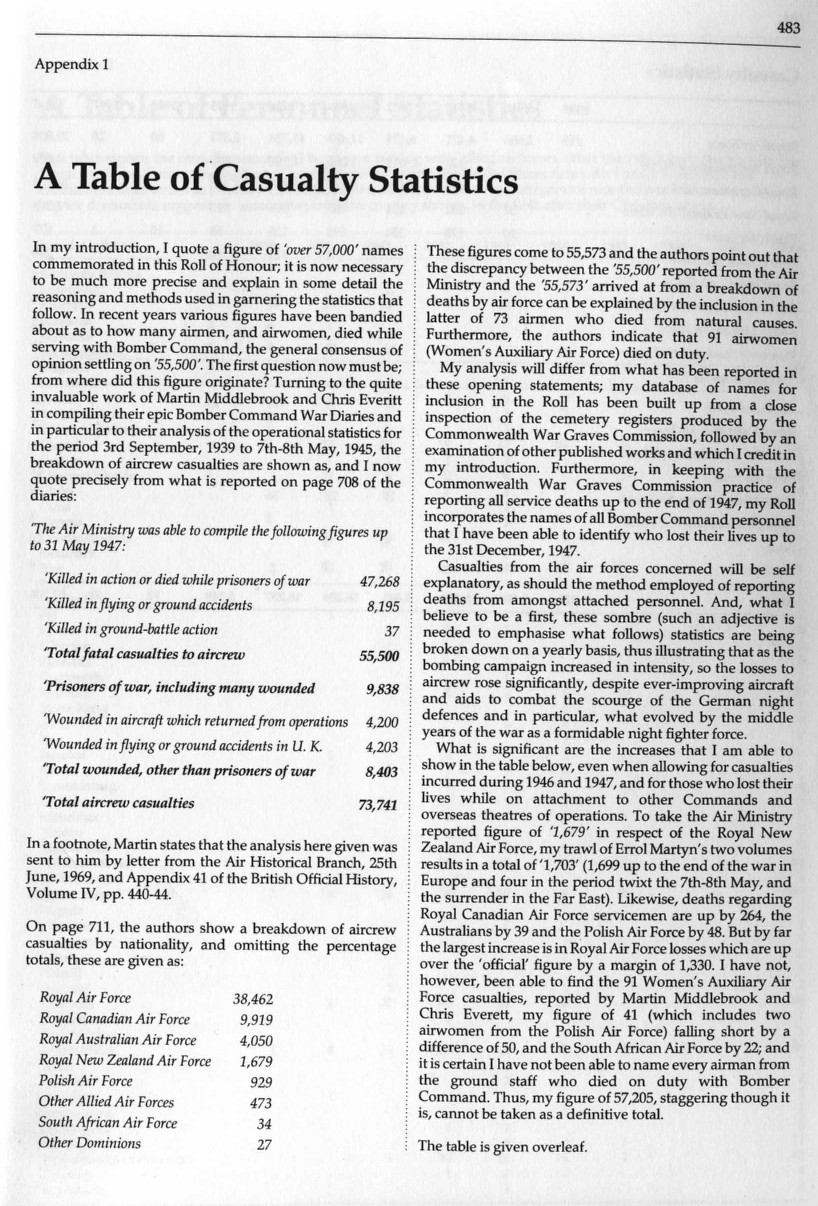
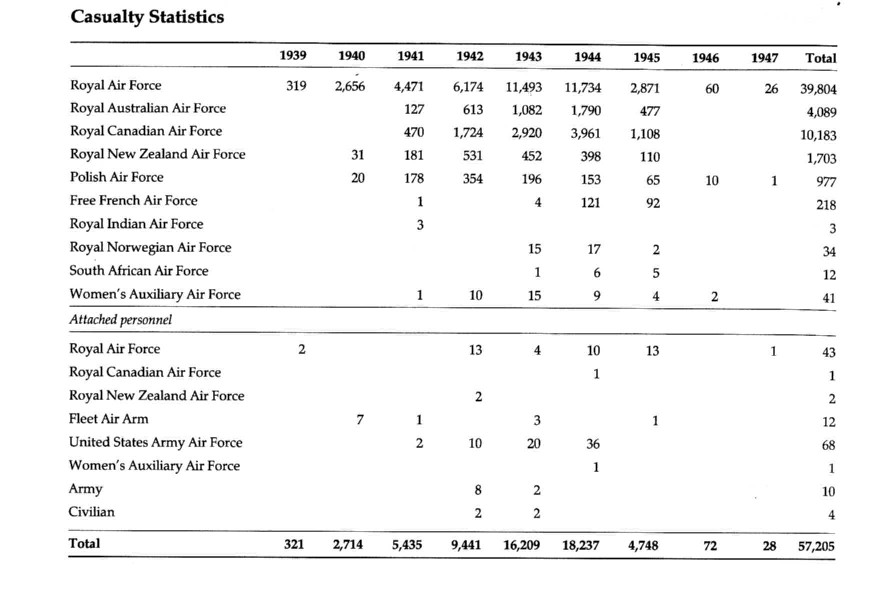
A further breakdown of the 55,000+ Bomber Command casualties has been carried out by Chorley, in his final Volume of Bomber Command Losses (where he lists every single one of these by name, rank, service number, date and unit). However, the quoted Bomber Command Diary figures do differ from the Nuremberg Raid analysis.
He explains the breakdown thus:
Thanks.
That tends to support my recollection that training was very dangerous, as it’s at about the ratio of one in six of total deaths.
On the reasonable assumption that enemy flak over England was fairly minimal :D, it suggests that whatever the causes a lot of people died out of ‘action’.
I suppose one would need to know the people miles flown in training and on ops to garner a fair figure, but I suspect that rather more fuel was available for ops deep into enemy territory than blundering about in English airspace.
Is there a statistic about tail-gunners KIA compared to rest of crews?
I often read that it was the most dangerous place in a bomber…
Hi Rising Sun, thanks for the welcome and kind words.
I think you nailed the answer to your question on casualties vs aircraft lost by the aircraft returning with wounded or dead crew aboard and the craft being returned to service.
Seen doco’s with half the crews being taken off badly wounded or killed, while the bomber ‘‘seems’’ to be in reasonable shape, or at least repairable.
On the Strategic bombing offensive, it seems to still get a bad rap at times for failing to break the morale, or the production rates of the Germans until near the of the war and sometimes is thought as not cost effective and a waste of materials and manpower.
But the U.S. Strategic bombing report done after the war sums it up pretty well, saying in part…
''Allied air power was decisive in the war in Western Europe. Hindsight inevitably suggests that it might have been employed differently or better in some respects. Nevertheless, it was decisive. In the air, its victory was complete. It helped turn the tide overwhelmingly in favor of Allied ground forces.
The German experience suggests that even a first class military power – rugged and resilient as Germany was – cannot live long under full-scale and free exploitation of air weapons over the heart of its territory. By the beginning of 1945, before the invasion of the homeland itself, Germany was reaching a state of helplessness. Her armament production was falling irretrievably, orderliness in effort was disappearing, and total disruption and disintegration were well along. Her armies were still in the field. But with the impending collapse of the supporting economy, the indications are convincing that they would have had to cease fighting – any effective fighting – within a few months. Germany was mortally wounded.’’
It’s probably that the full effects of the collapse had not reached the enemy’s front lines when they were overrun by Allied forces that takes away the full impact of the bombing campaign.
I read an english language bokk; “Air Gunner”, I think, once. It contained some statistics on the matter.
I don´t recall the numbers, but piloting a US strategic bomber should have been a lot safer than being a gunner in the rear fuselage.
(The worst pilot-gunner “kill-ratio” must have been in the IL-2, many (armour protected) pilots survived a series of (much less protected) gunners.
Regarding Survival rates of US strategic bomber crews, I remember reading a passage in a book called my war by Andy Rooney, he was stationed with the 8th airforce in the beginning of the campaign. I think the tour was 24 missions before you were able to go state side and become a instructor. What struck me most while reading that chapter in the book was that due to the losses substained by the 8th airforce at that time it was mathmatically impossible to complete the number of missions required to return to the US. Ronney mentioned that that the high point of losses there were 28-30 year olds Majors and Col. that were leading the squads because there was no one else left. " of the crews returning back home none came from the 8th Airforce".
Kind of makes you wonder
That’s how my Great Uncle died - he was in Bomber Command, as a Navigator on a bomber which flew into a hill in training…
Oh , damn,sorry was it in day or night training?
I’m not sure - funny that being as he died about 40 years before I was born! All I know is that they never saw the hill they hit, so it will have been either at night or in bad weather.
Regarding the forum topic, how many crew’d a b-17? I watched Ken Burn’s ‘The War’ and a pilot said there were 10 people that flew in a b-17 over europe. He said at one point 110 people were lost in bomb raid. I think it was the Black Tuesday thing which was about bombing a v1 base or a german industry plant? Is the man correct? 10 is awefully alot of people i would expect like 6 poeple.
Ten is right! 1 tail gunner (“tail-end charlie”), 2 waist gunners, 1 ball turret gunner, 1 radio operator, 1 bombardier, 1 top turret gunner/technician, 1 navigator, 1 co-pilot, 1 pilot.
i was aware only of the 1 tail gunner , 2 waist gunners, 1 ball turret gunner, 1 top turret gunner/technician, 1 co-pilot, 1 pilot. I assumed that some of them would also do 2 jobs simultaneously like navigating and bombarding.
Some crew were dual-trained, in addition to basic first aid skills. This applies to both US and Brit crews.
Statistically, oddly enough, the safest crew position in a B17 was the ball turret. Casualty risk was given as 10%, citing this figure from a post-war USAF study. This from “History of Aviation” Hodder and Stoughton, 1976.
As to training accidents, the toll of about one in 6 deaths seems correct, from reading the RAF History, which I did several years ago.
As to relatives killed.
A cousin of mine, was dorsal turret gunner in a Lockheed Hudson.
They took off from Gibraltar in morning fog, and the pilot was late making the 15 degree right turn after the wheels left the runway. The Hudson flew straight into the rock. The remains of the crew were identified by their teeth.
A genuine event.
Accidents on operations were rare, but happened, as did accidents in training.
My math teacher was ex RAF Navigator, Lancasters.
He was off duty one afternoon as Lancs took off to form up for a raid.
Two took off, and turned opposite ways, one to the right, the other to the left.
The fireball was 500 yards wide, at about 1500 feet above ground: 15 dead men before you could even pray for them. One of the Lancs had had a reporter onboard, to write up that night’s raid.
And one other casualty-causing factor needs mentioning regarding Lancasters.
As phenomenally good as the aircraft was, it killed a lot of crews, and the Air Ministry let it continue.
The fuselage escape door at the rear right was too small to permit an unassisted exit of a crewmember bailing out. A larger door had been designed, protoyped, built, but the Air Ministry refused to slow the production lines for long enough to have the new door fitted.
It was subsequently fitted to Lincolns and Shackletons, post war. This data from a newpaper article, circa 1980, still in my possession.
Regards, Uyraell.